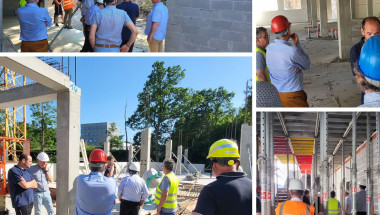
Since the project was launched in February, teams from Celabor and CEBEDEAU have been working together to turn an ambitious idea into a reality. And things are picking up speed: since January, two pilot reactors—one 500-liter and one 1,000-liter—have been running in CEBEDEAU’s basement, alongside the smaller reactors that continue to operate in the laboratory.
From Sludge… to Green Plastic
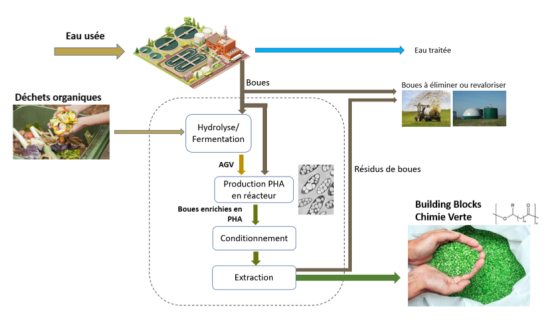
The concept may seem surprising: producing bio-based plastics from wastewater treatment plant sludge and organic food waste. Yet that is exactly what Sludge2BBi aims to do. The PHAs (polyhydroxyalkanoates) that the project seeks to produce are biopolymers naturally synthesized by certain bacteria. Both bio-based and biodegradable, they represent a serious alternative to petroleum-based plastics, particularly for food packaging.
A three-step process
It all begins with the fermentation of organic residues—waste from the food industry—to produce volatile fatty acids (VFAs). These acids are then injected into reactors containing our famous sewage sludge: the bacteria present in the sludge consume them and store the synthesized PHAs within their cells. All that remains is to extract and purify these polymers, using processes that are as environmentally friendly as possible.
The transition to the pilot scale: a key milestone
The launch of the pilot plant marks a decisive step. The goal is to produce PHA-enriched sludge on a scale large enough to test and optimize the extraction and purification stages, as well as to refine the process’s economic data. The results obtained will lay the groundwork for a future industrial sector in the Walloon Region, supporting the circular economy.
Developed as part of a Win4Collective project by the Wallonia Public Service.
Developed as part of a Win4Collective project by the Wallonia Public Service.