The future of micropollutants and antibiotic resistance genes
Micropollutants (MP), antibiotic-resistant bacteria (ARB), and antibiotic resistance genes (ARG) pose a growing threat to our environment and human health, resulting in increasingly stringent regulations on wastewater management, particularly in the revised Urban Wastewater Treatment Directive (UWWTD, 2024/3019/EU).
It was in this context that the CoMinGreat project was launched between 2021 and 2023. Its objective was to set up a platform dedicated to micropollutants for the Greater Region. An article presenting the project was published in 2023 on the CEBEDEAU website. It is available via the link
As the results obtained were promising, a scientific publication in the MDPI (Microorganism) journal was written in the Special Issue: Sustainable Approaches to Mitigate Antimicrobial Resistance in the Environment. Authors : Lena Brouwir, Hetty KleinJan, Charlotte Balent, Gilles Quabron, Fanny Gritten - CEBEDEAU and Irene Salmerón and Silvia Venditti - University of Luxembourg.
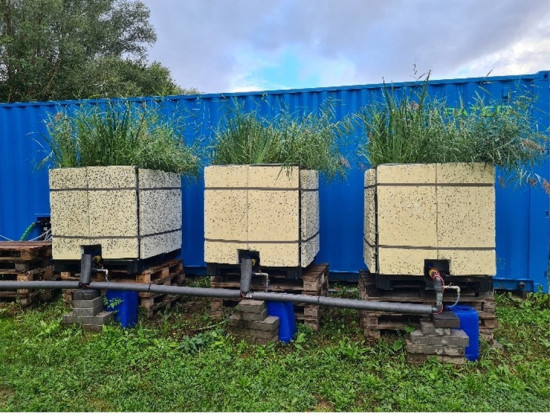
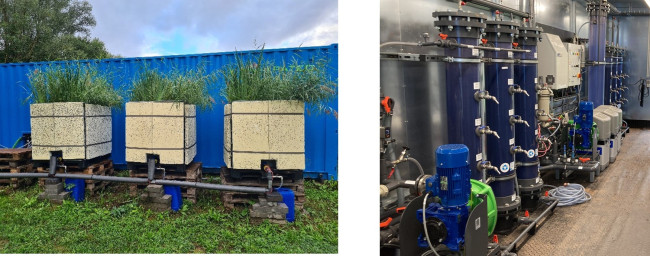
This article highlights the evaluation of the effectiveness of a vertical planted filter (VPF) as a natural solution for removing PM, ARB, and ARG from urban wastewater. The VPF was compared to two conventional quaternary treatments: granular activated carbon (GAC) and ozonation combined with GAC (O3-GAC). Three antibiotics were quantified (by LC-MS/MS) in parallel with ARGs (by qPCR and metagenomics) and bacterial profiling (metabarcoding and plate counting).
The effectiveness of the planted filter evaluated from various perspectives
The results indicate that, under the conditions tested, the PFV provides effective and stable removal of micropollutants and ARGs. This study highlights the potential of nature-based solutions to match advanced quaternary treatments in terms of removal performance and operational reliability, thus offering a sustainable and cost-effective means of reducing the spread of micropollutants and ARGs via wastewater.
In fact, the treatment plant reduced concentrations of N-SMX (N-acetylsulfamethoxazole) by more than 80% and SMX (sulfamethoxazole) by 66.3%. However, for CLA (clarithromycin), a 23.5% increase was calculated, demonstrating the low effectiveness of the wastewater treatment plant alone in removing this molecule. When the planted filter is added to the treatment, CLA is eliminated by more than 80% and N-SMX by more than 75%, demonstrating the effectiveness of quaternary treatment in eliminating micropollutants. However, there is an increase in the concentration of SMX.
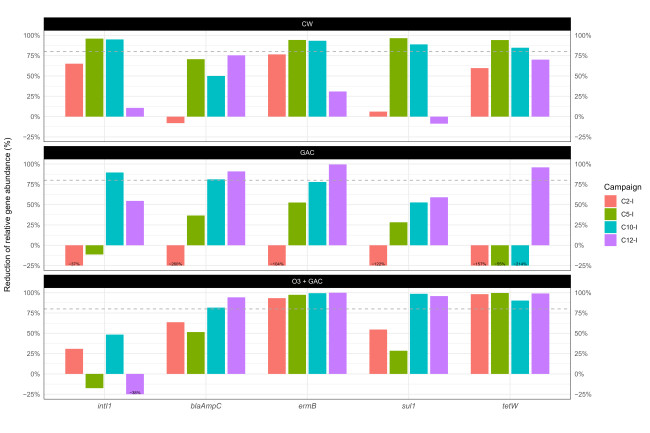
The removal rates of ARGs and class 1 integrase were calculated to assess the wastewater treatment plant's ability to remove them. For the four GMEs analyzed (blaAmpC, ermB, sul1, and tetW), removal efficiencies ranged from 35.17% (blaAmpC) to 97.82% (ermB). The wastewater treatment plant reduced the ermB gene by more than 80% at the outlet.
In contrast, the concentration of intI1 increased (313.99%) during the second campaign, indicating a higher prevalence of gene transfer out of the wastewater treatment plant compared to the inlet. In general, in this study, quaternary treatments reduced the amounts of ARGs (blaAmpC, ermB, sul1, and tetW) and intI1 more effectively than the wastewater treatment plant alone. The addition of the planted filter allows for adequate and reliable removal of all ARGs and intI1, with low temporal variability compared to O3 + CAG and CAG. Only minor effects of ARG release were observed in FPV. Although O3 + CAG achieved a similar average removal as FPV, its inability to remove intI1 highlighted the advantage of FPV.
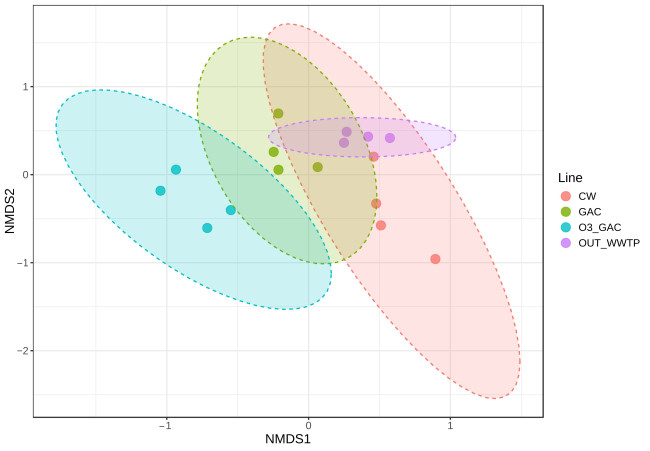
It was also observed that the bacterial communities found at the outlet of the wastewater treatment plant and in the FPV did not show any significant difference (p = 0.063), which is consistent with previous studies, in which it was reported that the communities described in FPVs are dominated by the same phyla as those found in effluents. In contrast, the CAG and O3 + CAG communities differed significantly from those of the OUT wastewater treatment plant (p = 0.036 and p = 0.029, respectively). The O3 + CAG treatment induced a distinct and significant change in the microbial community compared to CAG (p = 0.028), as described into scientifical papers.
Several bacterial genera have been reported to contribute to the removal of nutrients and antibiotics in planted filters through biotransformation, biosorption, or related mechanisms. In this study, genera associated with nitrification (Nitrosomonas and Nitrospira) were detected in the effluent (0.15 to 1.26%, which are the minimum and maximum abundances for all campaigns, respectively) and in planted filters (0 to 3.41%), while they were low or absent in the CAG (<0.29%) and O3 + CAG (< LOD).
Conclusion
In the context studied, vertical planted filters proved to be a robust and reliable method for treating urban wastewater contaminated with micropollutants. The results reinforce the added value of nature-based solutions as quaternary treatments for wastewater management in rural areas. In addition, planted filters enable the production of effluent that complies with reuse category B standards (water reused for applications such as food crops consumed raw, processed crops, and non-food crops), with E. coli concentrations remaining below 100 CFU/100 mL.
The knowledge acquired during this project will also be used in the QualiSûre project, which aims to identify emission hotspots and evaluate the purification performance, on a pilot scale, of vertical planted filters optimized for treating wastewater from treatment plants and storm sewer overflows. More info on QualiSûre.
These studies were carried out with funding from the Regional Research Fund (ERDF) and the Walloon Region via the Interreg V A Greater Region program (interreg-gr.eu).