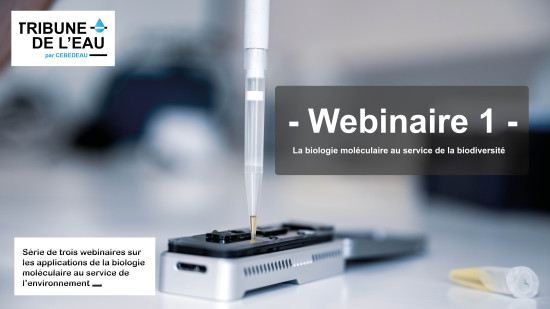
DNA sequencing, now more accessible and simplified, is revolutionizing the way we study ecosystems. These technologies make it possible to detect and track species with unprecedented accuracy, contributing to the preservation of biodiversity and the sustainable management of natural environments.
I subscribe to this first webinaire.
On the agenda:
📌 Lena Brouwir, Researcher - Project Manager at CEBEDEAU:
“What is environmental DNA? The various molecular techniques used to analyze it.”
📌 Angélique Gobert, Researcher in microbial ecology applied to aquaculture at IFREME & Vincent Ouisse, Researcher in benthic ecology at UMR MARBEC:
“Anticipating changes in marine macrophyte communities: the contribution of environmental DNA”
Mediterranean lagoons and coastal ecosystems in general are currently facing multiple anthropogenic pressures, both regional and global. This is resulting in changes to the structure, functioning, and services provided by these ecosystems. Understanding their future responses is a key issue in defining effective conservation actions to preserve or restore these ecosystems. Metabarcoding is now used as an integrative tool to characterize biodiversity based on environmental DNA (eDNA). This tool, commonly used in marine environments, has not yet been developed for macroalgae and marine plants, even though these species, often described as ecosystem engineers, play an essential role in forming habitats for many species. Led by Angélique Gobet and Vincent Ouisse, both researchers at UMR MARBEC, the MacDNA project aims to develop methods based on eDNA to assess the diversity of macrophytes and their microbiome, a potential indicator of the host's health. The presentation will focus on the project and the initial results obtained.
📌 Carole Guillaume, Researcher in Microbiology and Molecular Biology at LNHE – EDF:
“Molecular biology at the service of the water sector: industrial applications and biodiversity studies.”
Molecular biology, thanks to tools such as quantitative PCR, digital PCR, high-throughput sequencing, and environmental DNA (eDNA), is transforming water sector management by addressing two major challenges in particular: health safety and biodiversity preservation. This presentation highlights potential applications of molecular biology, from industrial controls (detection of pathogens in networks or biofilms, microbial ecology in water circuits) to ecological monitoring (tracking of endangered or invasive species, assessment of the health of aquatic ecosystems). eDNA, in particular, enables early and non-invasive detection of organisms, revolutionizing approaches to monitoring and restoring environments. EDF R&D's National Hydraulics and Environment Laboratory has integrated these methods into its research projects and is conducting studies to assess their relevance for securing its infrastructure and preserving ecosystems.